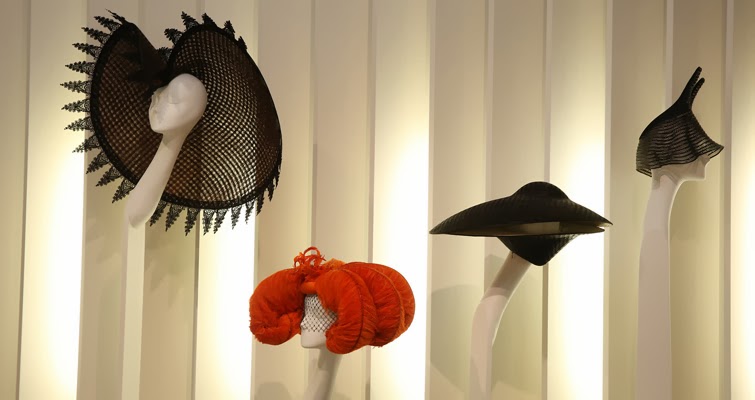
Hats by Philip Treacy from the personal collection of Isabella Blow (1958-2007). Photograph by Peter Macdiarmid/Getty Images for Somerset House.
If we were in London right now we would definitely be going to see Isabella Blow: Fashion Galore!, opening today at Somerset House. An editor, patron and muse, Isabella Blow was one of the most recognizable and important influencers in the world of British fashion. Perhaps best known for launching the careers of such luminaries as Alexander McQueen and Philip Treacy, Blow’s career spanned thirty years, during which time she was also a serious collector of fashion and art. This exhibition, presented in collaboration with the Isabella Blow Foundation and Central Saint Martins features over one hundred pieces from her personal collection, now owned by her close friend, Daphne Guinness. The exhibition catalog, with newly commissioned photographs of her tremendous assemblage, will be published by Rizzoli in February. We now have our fingers crossed that this no doubt fantastic and inspired show will make its way across the pond in 2014!
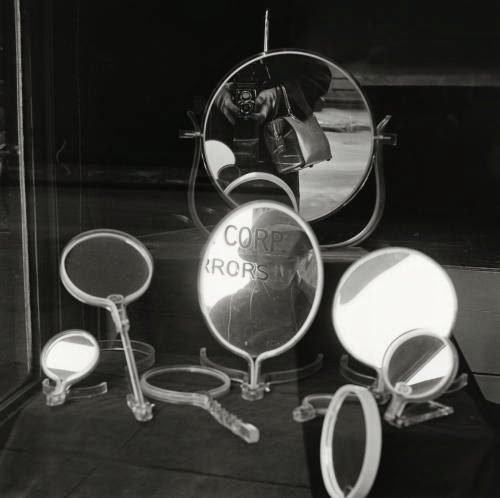
Vivian Maier (1926-2009), Self-portrait, 1955 The Maloof Collection
I have been following the work, and the remarkable story of its discovery, of American street photographer Vivian Maier since it was introduced to the world in 2009, just six months after her death. She is now widely considered to be among the most important photographers of her generation. I love her eye and the way she portrayed the world through her images — often humorous, quite intellectual, always considered. Born in Manhattan in 1926 to a French mother and Austrian father, Meier was raised mainly by her mother in New York and also in the French Alps for a time. It is believed she began taking pictures in the 1940s in Europe. In 1951 she accepted her first position as a children’s caretaker, a position she would hold with a number of families throughout her life, which enabled her to pursue photography, her mostly secret avocation. By the mid-1950s, Maier had relocated to Chicago where she would remain and whose streets became her subject matter.
To say that Maier was prolific is an understatement, to say that she was intensely private is not. After falling behind on rent payments at the storage facility where she kept her undeveloped rolls of film, negatives, slides and 8mm films, these tens of thousands of items were divided and sold at auction. One of these collections, containing some 30,000 negatives, was purchased by Chicago historian John Maloof. Her work had never been shown in public during her lifetime, it was Maloof who first showed us. In addition to numerous exhibitions, Maloof has also directed a documentary, Finding Vivian Maier, that premiered in September at the Toronoto International Film Festival and will be released in 2014. And last week, Vivian Maier: Self Portrait opened at Howard Greenberg Gallery, a wonderfully curated show and one definitely not to be missed. Vivian Maier: Self Portrait runs through December 14 at Howard Greenberg Gallery, 41 East 57th Street, NYC www.howardgreenberg.com https://www.vivianmaier.com/film-finding-vivian-maier/
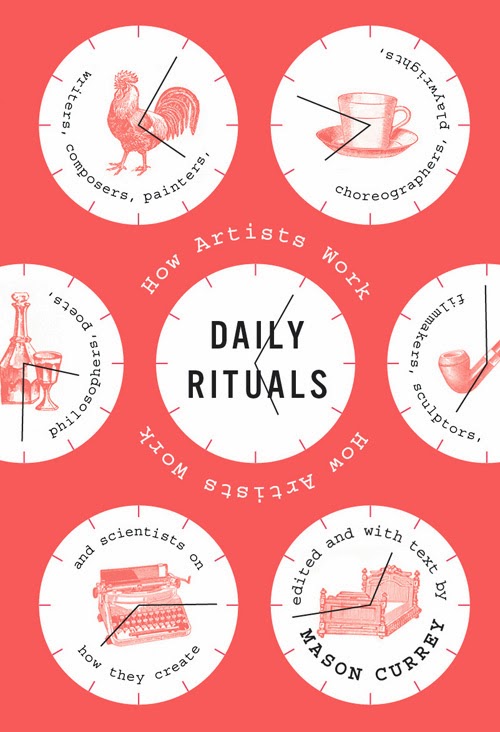
I often think about and grapple with, and I know a number of my writer and artist friends do as well, if the way in which I work each day is the most effective and efficient given a very full life and work schedule. I was so intrigued when I discovered Daily Rituals: How Artists Work, a new book by Mason Currey. Born from his blog, Daily Routines, Daily Rituals is a compilation of how some 161 of the world’s most brilliant creators work or worked, or in some cases didn’t, on a daily basis. I must say, after reading these fascinating and quite diverse accounts (we’re talking Simone de Beauvoir, Igor Stravinsky, Haruki Murakami, Louise Bourgeois, Andy Warhol, Albert Einstein…), I found myself inspired and reassured to carry on with my own daily ritual very much as it is, with a few more mind-clearing walks thrown in to the mix. Daily Rituals: How Artists Work by Mason Currey (Alfred A. Knopf, New York, 2013)
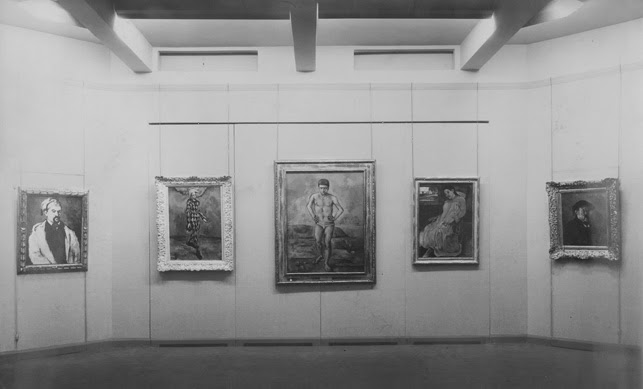
The Museum of Modern Art opened 84 years ago this week in the Heckscher Building, 730 Fifth Avenue (corner of Fifth Avenue and 57 Street) on November 7, 1929. The museum rented six rooms on the 12th floor for galleries, offices and the library. MoMA’s first exhibition, Cézanne, Gauguin, Seurat, Van Gogh ran from November 7 – December 7, 1929. Photograph by Peter Juley, The Museum of Modern Art Archives, New York.
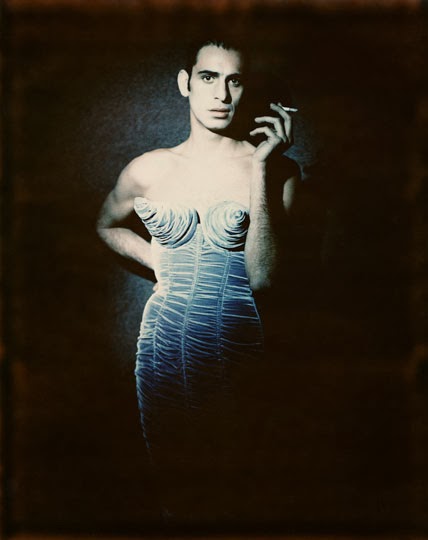
The highly anticipated exhibition, The Fashion World of Jean Paul Gaultier: From the Sidewalk to the Catwalk, opened a couple of weeks ago at the Brooklyn Museum. We first saw it at the Montreal Museum of Fine Arts in 2011, the first stop on its international tour. The only exhibition to date devoted solely to Gaultier, it was definitely one of our favorite shows of the year. It is of course amazing to see so many of his pieces gathered in one space, some 140 in total. But it is very much a multimedia experience, with sketches, photography and film as well. The exhibition design is quite remarkable, especially the interactive mannequins that we still think about more than two years later. And we understand that there is a new element here in New York dedicated to Gaultier’s muses. We’re on our way to Brooklyn! The Fashion World of Jean Paul Gaultier: From the Sidewalk to the Catwalk runs through February 23, 2014 https://www.brooklynmuseum.org/exhibitions/jean_paul_gaultier/
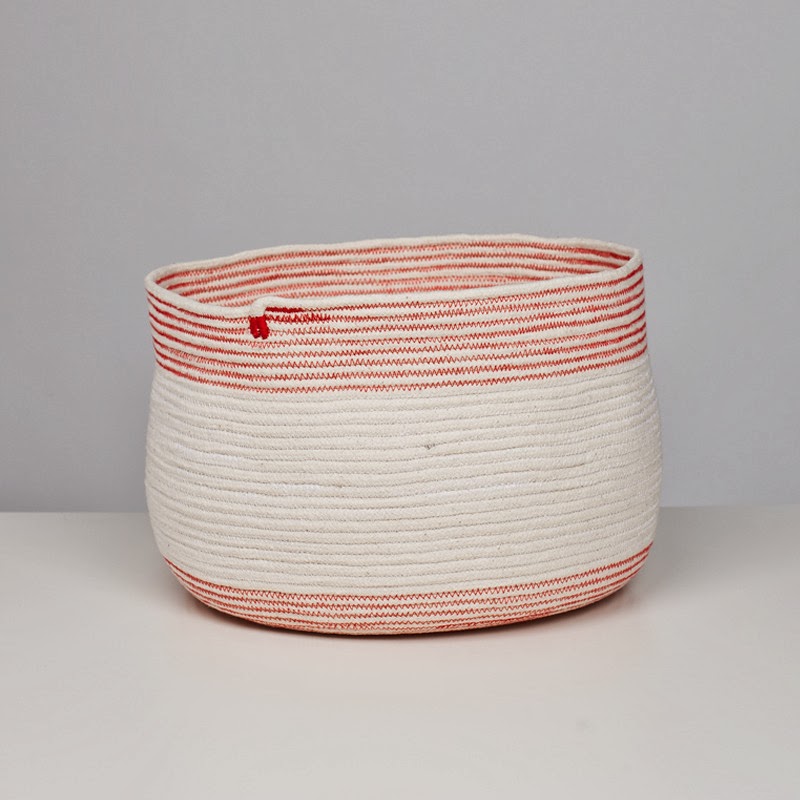
We recently spotted this beautiful Doug Johnston basket in Vogue. Upon finding his website, we discovered an incredible line of cotton cord baskets and bags handmade by Johnston, an artist and musician, in his Brooklyn studio. He also makes some very cool light sculptures and stools out of cotton cord. We love his minimalist, organic aesthetic and the integrity that seems to exist in each piece. His work is most definitely what we are craving right now.
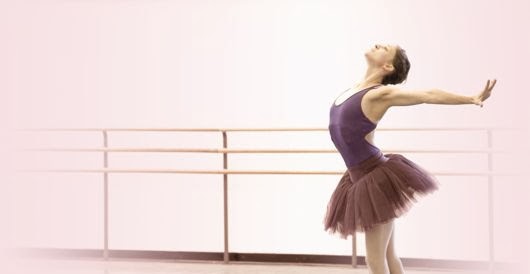
The new series city.ballet. premiered yesterday on AOL On Originals. I must admit I watched all 12 episodes straight through, each less than 10 minutes long. For the New York City Ballet enthusiast or any fan of dance for that matter, this is certainly a series worth watching. Produced and narrated by Sarah Jessica Parker, it offers a fascinating behind the scenes look at NYCB with each episode focusing on a different aspect of the company or the life of a ballet dancer. The series feels rather intimate in fact, with quite a lot revealed. city.ballet. is just one of a number of series from AOL On Originals. Another we like very much is Inspiration Point with Jonathan Adler, who, based on this series, is as fun and fantastic as we always imagined, perhaps even more!
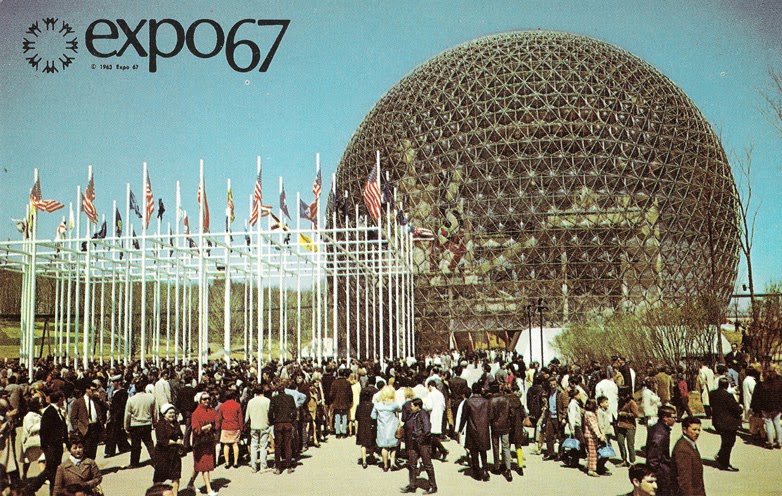
Photograph from Expo 67 in Montreal that ran from April through October 1967. Inventor and architect R. Buckminster Fuller designed the geodesic dome that served as the United States Pavilion at the fair. Fuller’s dome still stands and now inhabits the Biosphere, Environment Museum.
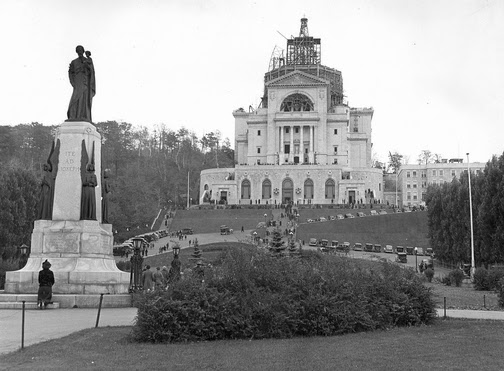
Standing at the highest point in Montreal on lovely Mount Royal, Saint Joseph’s Oratory was built over the course of 42 years on a wonderful property with some of the most breathtaking views of the city. The exterior is designed in the classic Beaux-Arts style, its dome being the third largest in the world. The interior, completed in 1966, is decidedly and wonderfully modern. Saint Brother André, a native Québecois, started a chapel in honor of Saint Joseph in 1904. Having outgrown the space, plans for a larger church were put in place in 1916 and construction of the basilica began in 1924. Masses of followers made pilgrimages to Montreal to see Brother André during his lifetime as he was known to perform miracles. I have long felt a connection to this place because my grandmother was one of those followers in the 1930s who firmly believed she herself was healed by Brother André. www.saint-joseph.org/en
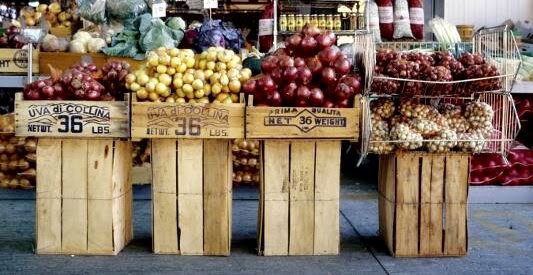
No trip to Montreal is complete without stopping at one of the city’s wonderful public markets — Marchés Publics de Montréal. Our favorites include the Atwater Market and the Jean-Talon Market. Jean-Talon is especially magnificent. You could spend hours there, it is that huge. In addition to the numerous fruit and vegetable vendors, there are fishmongers and cheesemongers, butchers, sellers of eggs, sweets, wine, olive oil, and flowers, and so much more depending on the season. Open every day, all year long, it definitely feels like the open air markets in Europe, completely transporting.